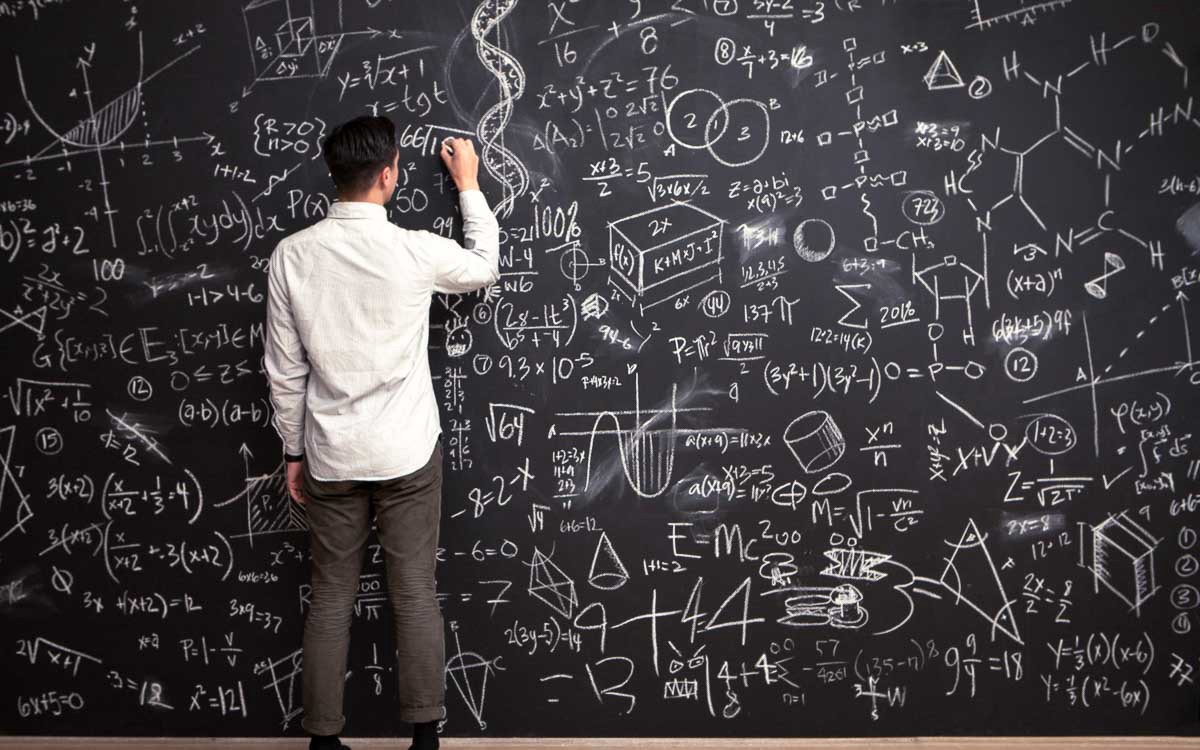
The Future Of Mathematics

Mathematics creates a dilemma: most people agree that it is an important skill to have for everyday living as well as the economic future of the country, but it is socially acceptable to be “absoulutely useless at maths”?

The state of mathematics in the UK bubbles to the top of the news headlines: Numeracy skills have got worse, not better and Asia tops biggest global school rankings. Experts opinion are sought on the state of mathematics; they give advice on what needs to be done. Journalists bounce the subject around: For Britain’s pupils, maths is even more pointless than Latin,and Maths isn’t the problem - the way it’s taught is. All of this is against a background of drip fed statistics: adult numeracy has dropped from 26% of the population in 2003 to 22% in 2011, and eight out of ten people don’t know what APR means let alone how to calculate it ( a sizeable minority think it’s short for April ). Government ministers respond with tweaks to the mathematics curriculum fully expecting a swift implementation. But the topic sinks back down to the lower depths of the public consciousness. Until the next survey sparks another heated debate.

The problem with developing skills in mathematics is failing to recognise that it is a language. A language that uses numbers, not German or French. And like most languages it is a skill that has to be practiced regularly. The language of mathematics consists of activities that involve additions, subtractions, multiplication and divisions which are used to quantify the amount of money in our banks, search for the best deals on the web and and count the number of days left before our next holiday. Like any other language, our skill in its use is linked to how important it is in our lives. Even equations with their strange appearance of \(x\) and \(y\)’s have an important role in our lives. When understood mathematical symbols can unlock a new set of skills that can have many applications, for example working out compound interest which is important in calculating the amount of money required for a happy retirement.

President Ronald Reagan once remarked “you persuade people through reason but motivate through emotion.” In the case of mathematics there are enough reasons to persuade people about its importance: managing household budgets, improved job opportunities, transferable skills, planning for the future, improved critical thinking and so on, but how can people be motivated to use mathematics?

Like learning any language the earlier it is started the better. It builds confidence and reduces the anxiety that many experience in later life. The early stages of mathematics requires a lot of practice: counting, multiplying, dividing, measuring, and so on, but this can be done by applying those skills to problems that affect everyday life. For example, managing pocket money, writing software to monitor local wildlife, building models to predict the impact of waste on the local environment around the school etc.

Another area is the impact of mathematics on the world that we live in. Mathematicians, and those who use mathematics, need to communicate to as wide an audience as possible about the benefits that mathematics can bring rather than discussing the latest solution to an equation. Also, those with mathematical skills need to make connections to other areas of society ( rather than on-going areas of academia, industry or governments ) and make new links e.g. health, social problems, etc. Breaking into new areas will create a pioneering spirit which could motivate others to join in.

In the public domain more effort is required to raise the profile of mathematics. Mathematics institutes and organisations reinforce academic achievement when they should be analysing the level of mathematics skill in the population - why don’t they walk around supermarkets and ask shoppers about using mathematics rather holding another survey amongst themselves? And where is the popular face of mathematics? Where is mathematics Brian Cox? If there was a popularity vote between Brian Cox and Marcus du Sautoy ( the closest equivalent to Brian Cox ) then I feel the Professor Cox would win by a mile! Those involved in mathematics should ask why that would be and then take what can be learned and apply to promoting mathematics.

Therefore the challenge, and plea, to mathematics teachers, authors, experts, governments and industry is to develop an understanding of the emotional aspects of mathematics and then tap into it to motivate its greater use, rather than wasting time and money on another survey. Maybe the next time a celebrity proudly claims that they are ‘rubbish at maths’ then the web will crash with the volume of clicks as people unfollow or unfriend them !

There is always an awkward moment when meeting people for the first time and the conversation turns to “What do you do ?”. I am thrown into a dilemma: do I include in my reply that I am an Engineer ( or worse a Systems Engineer! ). When I blurt out something about being an Engineer their reply is usually along the lines of “Good we need lots of Engineers to get us out of this recession” and then they quickly move onto the price of houses or the weather.

However, the situation is changing. In a recent Harvard Business Review about the Best-Performing CEO’s in the World an interesting result emerged: 24 out of the top 100 CEOs are Engineers. The results also show that Engineers can head up non-technical companies. Not bad for a profession that has a public perception of repairing things!

An Engineer, can bring many qualities to business leadership. By the very nature of their profession, an Engineer takes a practical approach to problem solving. They break down complex problems into their component parts and then rebuild a new solution. They are restless in improving the performance of whatever they are working on whether it is making a car faster, safer or more fuel efficient. This urge to improve can best be summarised by one of my old lecturers who observed: “if you want to maintain the status quo – don’t get an Engineer involved. The first thing they will do is take it apart to understand how it works then put it back together in a way that makes it better” How many businesses can afford to maintain the status quo ?

Change is at the heart of any business, whether it is driven by competition, technology or legislation. An Engineer can apply their capability in taking a systems view to a business, and with their analytical skill, they can make decisions about parts of an organisation that will improve a businesses overall performance. Also, they instinctively take into account the risks and include safety margins to ensure successes. However communication is key in any change in a business and because an Engineer usually has worked their way to the top they understand the intricate workings of a business and can communicate effectively to different levels. All this adds up to successfully managing change.

Finally engineers can be both detailed and yet take a broader view of the environment that the business is working in. History is held together by many examples: Isambard Kingdom Brunel who changed the shape of a countries transportation system which increased its wealth, Henry Ford introduced techniques of mass production that are still followed today, and Amazon’s Jeff Bezos who continues to revolutionise how we shop.

I am now looking forward to meeting new people and when the awkward point in the discussion comes I will confidently add to my reply “ … and one of the fastest growing professions in business leadership!”

John Lennon famously said, “Life is what happens while you are busy making other plans”. And so it did. I had planned a week of developing ideas, gathering data for a project, business meetings and so on. Then life struck. With a bladder that felt like the size of a football I was rushed to the local Medical Centre where a urinary catheter was inserted to my great relief! Everything was put on hold. However, as an engineer with an interest in equipment that helps people manage, or recover from, an illness the situation was one I had explore further.

The purpose of a medical device is to “diagnose, prevent, or treat a disease or other conditions, and does not achieve its purposes through chemical action within or on the body.” They can range from disposable gloves through to Robotic Surgeons. The market for medical devices is projected to be a market worth $398 bn globally by 2017. The urinary catheter market is estimated to be worth $2.37 bn by 2020. Big business !

The urinary catheter has been around for 3500 years. The earliest ones consisted of bronze tubes, reeds, straws and curled-up palm leaves ( ouch ! ). The device has evolved throughout the centuries to the one that I used with all of its parts made from soft plastic. There must be many design challenges and off the top of my head they would include: minimise infection, no leakage, minimal pain during installation and extraction, ease of use for example when changing the bags. The actual list I am sure will be significantly longer.

Using the catheter requires some basic plumbing skills that most of us who connect garden hose pipes can easily master. The valves used on the bags are an example of keeping it simple with an intuitive way of switching it off and on. Also, through trial and error with a series of bands I managed to strap bag and pipe onto my leg in such a way that I could walk normally.

For my own interest, I started to gather data on how much I was drinking and volumes when emptying my bag ( inputs and outputs in engineering terminology ), which produced a fascinating insight into how my body was working. Given the problem that the catheter is managing - emptying urine from my body - and the constraints of everyday use, the one I used worked well.

It is interesting how the world changes for the user of a medical device. In my case, public toilets were key points of reference when out shopping. I developed a mental map of where and when the toilets were open. Of course planning is critical to cover all eventualities when out and about especially when drinking too much ! Another aspect that I didn’t fully appreciate was the reaction of others when using disabled toilets. Because I ‘looked normal’ the waiting queue outside the toilet would glance disapprovingly.

One final point. The District Nurses gave me great practical advice based on their experience of helping other people managing their catheters. For any medical device designer getting feedback from the people who are using it is an invaluable source of information for revisions to the design. In general, the users of medical devices can very often find better solutions to the problems of using it, even if it involves Duct Tape !

Next time I am sitting in the waiting room of my medical centre, probably listening to some John Lennon classics, I will be reflecting on the many people, over the centuries, who developed the urinary catheter and how the current version saved me from torturous pain !

Big thanks to the Doctors, Nurse Practitioners, District Nurses, and the people in the Dispensary for their professionalism and kindness during my urinary problem.

Probabilities crop up in the news, documentaries and blogs everyday. They cover a wide range of activities: will it rain today?, what are chances of becoming ill ?, or to place a bet or not? They seem to cover most aspects of life. But what is a probability?

When we flip a coin into the air to decided whether to stay in and watch TV or go out for a meal, then as it twists and turns there is no way to predict which way it will land. The decision has been left to a random outcome. It could land heads, or it could land tails. There is no way to predict. To quantify the uncertainty we calculate a probability. To do this we need to know the number of possible outcomes, in the case of a coin it is 2 - landing heads or landing tails. Therefore the probability of landing heads is 1 of 2 possible events which gives “1 in 2 chance of heads” or a probability of 1/2 or 0.5 ( in percentages “50% chance of landing heads” or in gambling terminology “evens” ). All probabilities follow the same principles but the calculations can be different.

In the case of predicting the weather it can’t be flipped up in the air like a coin ! Instead, the UK Meteorological Office uses mathematical models. The models describe the relationship between a very large number of variables for example temperature, pressure, wind speed and direction at points across the country. Combining the models with measurements from weather stations they use lightening fast computers to calculate the probability of rain in a region. Chances of rain are watched eagerly by farmers about to harvest their crops, events organisers wondering how many umbrellas to order, and supermarkets making sure they have enough ice cream to sell.

To plan the amount of resources required for patients, health organisations use medical records to calculate probabilities of developing a disease. In the case of cancer, medical records show how many people have developed one of the many different forms during a lifetime. All this information is gathered together and probabilities are calculated. For example in the UK population there is a 1 in 3 chance of developing cancer at some point in a lifetime.

Gambling is big business, in the UK it is approximately £14bn per year, and covers many activities from sport to whether it will snow on Christmas Day. Take football, at the beginning of the football season all teams have an equal chance of coming top of the league table by the end of the season. However, some teams have a stronger squad of players, or new managers bring different ideas about improving the performance of the team, and so on. Bookmakers take all of the factors and assess the chances of a particular team winning the league and offer odds, say 6-1 ( “6 to 1” ). In other words, the bookmaker thinks there is 6 times more chance of the team not winning the league compared to it winning ( equivalent probability is “1 chance in 7” or 14% chance of winning ). A gambler ( or punter ) places an amount of money with the bookmaker hoping that they are wrong and they win lots of money !

Probabilities quantify the level of uncertainty that a particular event will occur - they are a guide and not a prediction. They can be used to plan for rainy days, help the health system to prepare for future illnesses, and avoid losing money !

Dear Nobel Prize Committee Members,

For many years I have read the lectures given by the Nobel Prize winners. They give a great insight into the personalities of the winners and their struggles to break new ground in their subjects. The Nobel Prize highlights some of the greatest breakthroughs in our understanding of the world that we live in, and although I don’t claim to understand every aspect of the lectures, I find them inspiring. However, it is a curious fact that there is no Nobel Prize for mathematics.

I understand that when Alfred Nobel left most of his fortune for a series of prizes which he stated were for those who have shown the “greatest benefit on mankind.” However he limited the subjects to physics, chemistry, physiology or medicine, literature and peace. Although I can appreciate that there are many reasons for limiting the number of prizes, missing out mathematics is a serious lack of recognition of its impact on the “benefits of mankind.”

I would like to you to consider a Nobel Prize for Mathematics. Mathematics forces a clear understanding of concepts and assumptions involved in a problem. It provides a logical framework for exploring and understand the world - where would we be without numbers, geometry and algebra ? Mathematicians use their skill, determination and imagination to extend the boundaries of our knowledge and develop methodologies and techniques that when applied improve the way that we live. It is interesting to note that outside of the awards for literature and peace there is invariably some form of mathematics supporting the subject that has been awarded a prize.

Since the first Nobel Prize awarded in 1901 mathematicians have made significant breakthroughs in our understanding of the world, for example: Alan Turing ( widely considered to be the father of theoretical computer science and artificial intelligence ), Emmy Noether ( landmark contributions to abstract algebra and theoretical physics, in particular explaining the link between symmetry and conservation laws in physics), John von Neumann ( a pioneer in too many fields to list but include physics and computing, in particular the underlying computing structure used by every computer today ), Rudolf E. Kálmán ( breakthrough in filtering theory which was first used in Apollo navigation systems and today is guiding commercial aircraft and analysing the weather ), Beniot B. Mandlebrot ( developing insights into rough or chaotic physical phenomena seen in shore lines to societies ) are just a few who could have been considered for a Nobel Prize in mathematics. Imagine how many more breakthroughs in mathematics there would have been with the support of £600,000 prize money !

Of course there are already awards for mathematicians, for example The Abel Prize which is considered the ‘maths Nobel’ and through the media raises the profile of mathematics. However, the Nobel brand would raise the profile of mathematics to a higher level and a wider audience.

Although the list of Nobel prizes has stuck to the original list of prizes, adding another subject has been done. The Sveriges Riksbank Prize in Economic Sciences in Memory of Alfred Nobel, donated by Sweden’s central bank to celebrate its tercentenary in 1968 has remained on the list. I can appreciate that money will be required to support the on going prize for mathematics. However, if you signalled that you were open to the idea of adding mathematics to the list of prizes, then maybe some of the major companies who rely on mathematicians such as Amazon, Google, Apple, and Microsoft, might be willing to set up an endowment to provide the on-going financial award - what do you think ?

I can appreciate that you are busy assessing future recipients for the Nobel Prizes, but please can you find time to consider adding mathematics to the list. Its inclusion to the list of Nobel Prizes will finally recognise its impact on the “greatest benefits of mankind”.

Best regards,

A Mathematician